Robin Sparrefors
Principal, Head of Strategy & Growth
How business-driven IP teams turn strategy into intentional patent positions
Conventional patent creation approaches fall short when the pace of business change accelerates. They were developed to capture inventions from stable, ‘steady state’ businesses, not to shape the patent portfolio an evolving business requires.
Progressive IP organizations close this gap by adding IP Catalyst capabilities. The Catalyst – a capability either embodied in a dedicated role or made part of the responsibilities of existing IP roles – works proactively, building close relationships with business and technology stakeholders and inventor communities, and taking responsibility for engineering portfolios with clear business intent rather than waiting to capture whatever happens to be invented.
The IP Catalyst capability is difficult to scale. It requires a rare combination of business acumen, technical depth across multiple domains, and working IP knowledge. These multi-skilled profiles are hard to find and even harder to retain.
LLMs and AI can bridge the scaling gap. AI-enabled portfolio engineering amplifies the Catalyst capability by carrying the information load and broadening the reach of each individual. It gives IP Catalysts the decision support needed to be both business-driven and effective at scale.
Not just any AI will do. Both generic LLMs and purpose-built but disconnected AI tools tend to create noise, false confidence, and disconnected outputs. What is needed is purpose-built AI that embeds in the company's workflows and goes beyond language processing: AI that connects business strategy, technology landscapes, and patent positions into a single, coherent picture.
Most conventional IP organizations are built around reactive IP capture. They perform well when the business is well understood, R&D follows predictable paths, and the IP team can rely on established inventor communities and invention capture processes. In these settings, conventional IP teams efficiently translate inventions into legal protection. What they typically don't do is ask whether the right invention disclosures are being produced, or take responsibility for shaping and engineering the portfolios the business actually needs.
The limitations of reactive IP capture become most visible when the pace of business evolution increases. Entering new fields, responding to aggressive competitor moves, and navigating external pressure, are all activities that can expose the gap between what the business needs and what the IP function delivers. The gap is not only a problem in times of drastic change. Even in periods of relative stability, an IP function that captures only what inventors bring forward is systematically leaving strategic positions undeveloped.
This gap can take many forms in practice, all of which can severely impact business outcomes:
For most companies, the pace of business evolution has accelerated with digital transformation and AI, surfacing these gaps on a recurring basis. As a result, the question is no longer whether to upgrade how patent portfolios are shaped, but how to do it systematically and at scale. For many progressive IP organizations, whether already world-class or still on the journey, the answer is a structural move, namely a non-traditional, proactive IP capability: the IP Catalyst.
The IP Catalyst is a capability rather than a fixed job title. It combines business, technology, and IP skills, and complements the traditional work of attorneys, paralegals, and portfolio managers. In some organizations the capability is embodied in a dedicated role, in others it is carried by existing IP professionals shifting their responsibilities and approach. Unlike conventional IP work that responds to what inventors bring forward, Catalyst work runs ahead of the curve: helping business and technology leadership define the portfolios needed before strategic moves are made, collaborating with inventors to shape and stimulate invention as those moves unfold, and consolidating the resulting positions as the business settles into its new state.
At its core, Catalyst work is analytical and grounded in a business-IP intelligence mindset, drawing on the business context, technology landscape, competitor moves, and IP data to build a holistic, data-driven picture of where patent positions matter.
Working this way shifts the focus from capturing what happens to be invented to deliberately shaping where inventions should be captured and what IP portfolio the business needs. This is what business-driven portfolio engineering means in practice.
The IP Catalyst is not necessarily a formal job title. It is a capability that can be embedded in different IP organizational designs, roles, and team setups.
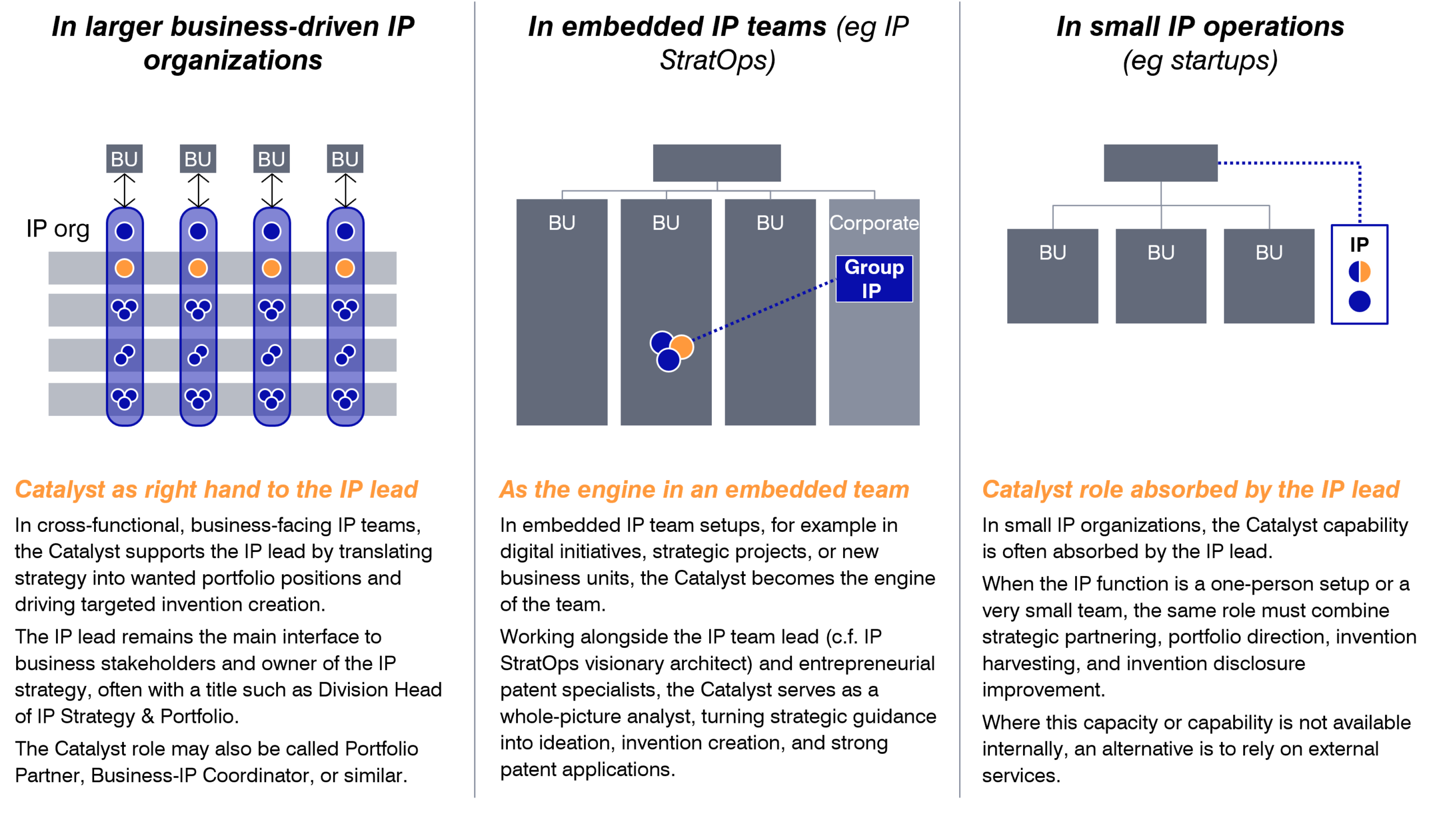
IP Catalyst work typically operates across three main interfaces in portfolio engineering:
The IP Catalyst model is powerful, but difficult to scale through traditional methods alone.
A first challenge is the scarcity of appropriate people. Practicing as an IP Catalyst (in a dedicated role, or as part of an existing IP professional's broader responsibilities) requires business understanding, deep technical insight, and working IP knowledge, often across multiple changing domains. Few people fit this profile, which quickly starts to resemble a multi-skilled superhuman. These individuals are both hard to find and even harder to retain. When skilled Catalysts leave, the accumulated context, relationships, and judgment leave with them, and the organizational memory and capability disappear.
A second challenge is the intensity of both information and judgment required, and the limited reach this imposes on any one individual. Understanding business models and dynamic competitive environments, navigating patent landscapes, connecting developments across technologies and markets, and maintaining consistency across multiple initiatives, all require significant effort, and the number of business areas one Catalyst can credibly cover is a hard ceiling on the scale of the work.
Taken together, these challenges mean that even organizations with strong intent often find themselves falling back into reactive patterns.
That is where AI comes in.
AI-based solutions are increasingly able to improve the scalability and effectiveness of the IP Catalyst capability in portfolio engineering, and the AI solution market for proactive and business-driven IP work is still evolving. The market has already seen several early AI solutions to support ideation and portfolio decision making, and we expect the market to continue to mature as capabilities from foundation models like those of Anthropic and OpenAI are increasingly integrated into purpose-built tools and platforms.
As these platforms and tools develop, several areas of Catalyst work stand to benefit. AI can support the Catalyst in target portfolio definition by helping structure complex business, technology, and IP information to clarify where value is at stake, where friction is likely to emerge, and where control points matter most. AI can also strengthen invention support by rapidly analyzing large technology and patent datasets, giving stakeholders a richer understanding of technical context, competitor activity, white spaces, and available invention options. Finally, AI can help the Catalyst manage the disclosure pipeline with strategic business intent: ensuring the right disclosures are prioritized and shaped to close the gaps that matter, not just processed faster. This is where the Catalyst's judgment and AI's analytical reach combine to greatest effect.
This only works if the AI is built for the task. General-purpose tools have no view of the customer’s portfolio, workflows, or business priorities, and can at best speed up isolated steps without necessarily improving the patent output. The wrong AI tools can just as easily produce noisy portfolios, false confidence, and patents disconnected from what the business actually needs. At worst, the resulting patents could undermine the business position they are meant to support and create liabilities.
Even purpose-built IP tools are not automatically a better answer. Many are delivered as generic SaaS applications, equipped with IP-domain features but still disconnected from the company’s workflows and unable to be adapted to its technology and business context. What enables a real shift is purpose-built AI that does two things differently: it connects business context, technology landscapes, and patent positions into a coherent picture, and it embeds in the company’s workflows. This is the move from AI solving isolated IP tasks to AI-powered platforms for decision support. Platforms of this kind are still rare, but they are what the next stage of IP work will run on.
In the last few years we have increasingly seen AI-forward customers come up against the limits of purpose-built tools and try to fill in the gaps with generic services, resulting in outcomes that are too vague or generic to have actionable business relevance. We are repeatedly asked if the only solution is to build these holistic support platforms in-house, which is typically outside of the resource and competence constraints of most IP departments.
The shift from reactive capture to engineered portfolios is a structural change, not just a tooling upgrade. It depends on three parts working together: the IP Catalyst capability that brings business intelligence and judgment to portfolio decisions, an organization that lets the IP Catalyst plug into the right business, product, and inventorship contexts, and the right kind of purpose-built AI that lets that capability operate at the scale today's business demands.
Sapivia.ai is Konsert’s proprietary, knowledge graph-powered AI platform. It connects business, technology, and IP knowledge into a living digital representation of a client's competitive environment. The platform builds on Konsert's proprietary methods and decades of experience in business-driven IP management, and is developed by Konsert's own technology team with the backing of the Rouse Group CTO organization.
Through Sapivia, Konsert provides next generation AI-powered decision support for IP organizations across a broad range of use cases, including AI-enabled portfolio engineering.